Home › The Business Guinea Pigs › Volume 2
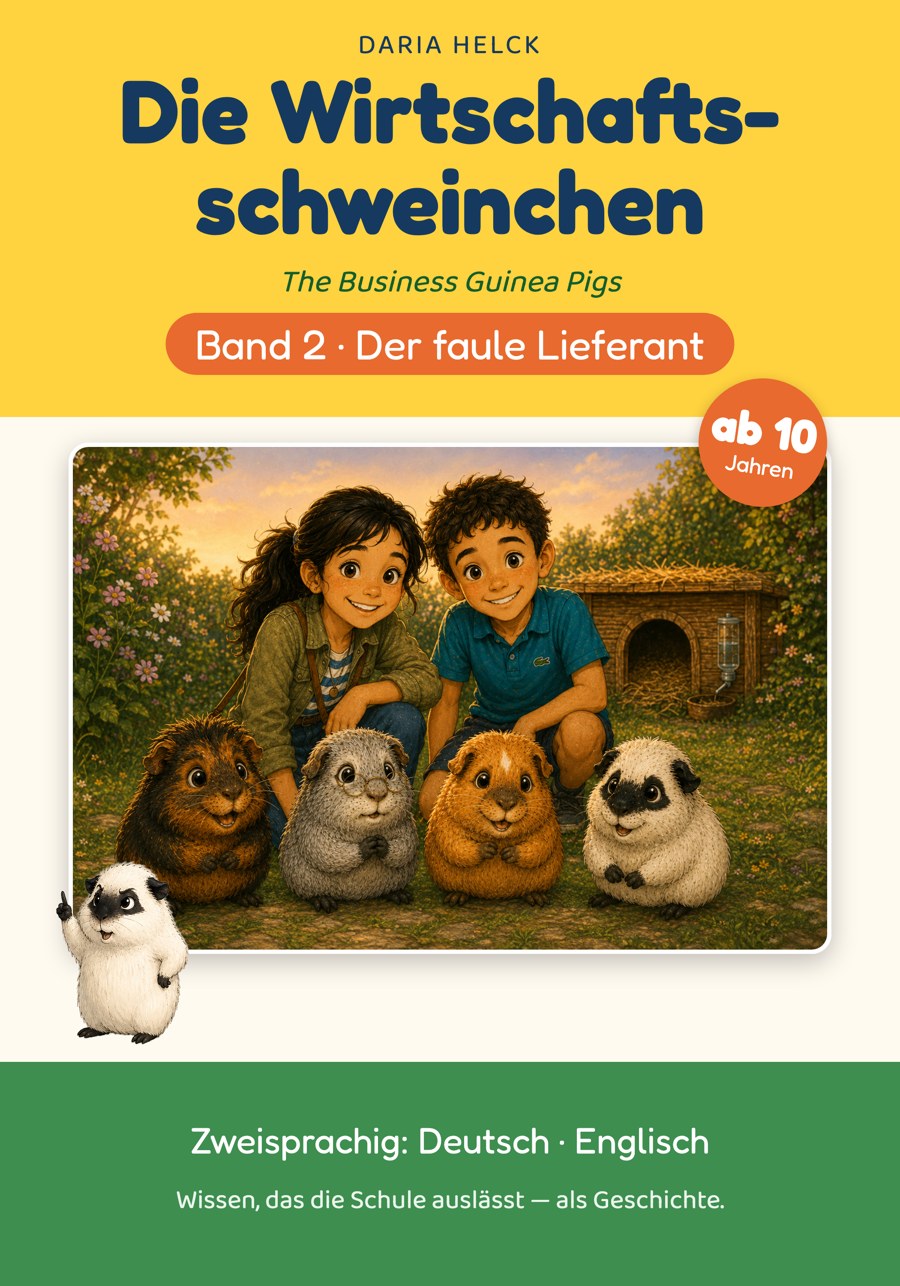
Volume 2 · ages 10+
Topic: contracts and consumer rights
The Business Guinea Pigs – Volume 2: The Lazy Supplier
Contracts explained simply for kids: from the fine print to making a complaint.
The mountain of food in the guinea pig enclosure is shrinking, and there’s a flyer in the mailbox: the Mega Nibble Box, only €12.90 instead of €24, super-fast delivery. Daria fills in the order card and signs it. Nobody reads the fine print.
Eight days later, a dented box is sitting at the gate. The hay is musty, the carrots are rubbery, and the invoice says that from now on a box will arrive every month. Time for Mojito’s magnifying glass.
- By Daria Helck, published by FLITCH UG
- For kids ages 10+, roughly grades 5 to 7
- Bilingual: every paragraph in German, with the English right below it
- 46 pages, illustrated in full color throughout
- Available as a paperback and as a Kindle eBook
What Volume 2 is about
Daria rushes ahead, even though she and Christian agreed: do the math first, then act. She signs the card with a curly D, delivery on invoice. Mojito sees it right away: they signed without reading. Mr. Grey explains why a filled-in card is already a contract, and even brings in King Hammurabi to do it.
When the box finally arrives, Toffy spits something out for the first time ever. For Rocky, that’s an emergency. The kids write a polite letter of complaint with an evidence carrot, and there’s a showdown with Knut at the garden fence. In the end he isn’t a crook, he’s just overwhelmed. The dispute turns into a new, fair contract, this time without fine print.
Contracts explained simply: what Volume 2 teaches
The book answers these questions. Here is a short summary, with the examples from the story.
What is a contract? Explained for kids
Daria thinks they only filled in a card. Mr. Grey sees it differently: a contract isn’t a thick folder with a seal. A contract is a firm agreement. One side offers something, the other says yes. Done. That even applies when you only say it out loud: if you order a bread roll at the bakery, you promise to pay, and the baker promises the roll.
Why do we have contracts at all?
So that you can rely on strangers. Mr. Grey tells the story of King Hammurabi, who had rules carved in stone almost four thousand years ago. His line on it: Contracts aren’t a cage. Contracts are the reason you can trust strangers. And a good contract doesn’t protect one side, it protects both.
Do you have to read the fine print?
Yes. Mojito measures the fine print on Knut’s card with a carrot: three carrots long. His rule: When the fine print is longer than the big print, something is wrong. The fine print is part of the contract. But it can’t do just anything, because there are rules above the rules.
What is a subscription trap?
The fine print says that by ordering the one box you sign up for a twelve-month subscription, €12.90 every month. Christian does the math: over €150 a year. Mojito calls it the oldest trick in the fine print: Up front the smash price lures you in, in the back the subscription sticks. The first warning sign was the flyer itself. Too cheap, says Mojito, always smells like a catch.
Is a subscription hidden in the fine print legally binding?
No. Mojito explains: the fine print may explain things and set rules, but it can’t slip in a nasty trap that nobody could see coming. If you order one box to try it, you don’t have to expect a yearly subscription. In Germany, a surprise clause like that simply doesn’t count. As if it had never been written there.
What can you do if something you bought is bad or broken?
Then the seller has a problem, says Mr. Grey. Musty hay and dust instead of pellets are a defect. Under German law, with a defect the seller first has to deliver a replacement. If the seller won’t or can’t, you pay less or give everything back. A line like “a sale is a sale” can’t magic these rights away. The law is stronger than any ant-writing.
How do you make a complaint the right way?
Politely, clearly and with everything on the table. Mojito’s line: Whoever has rights doesn’t need to shout. Mr. Grey crosses Rocky’s “With HORROR” back out. Christian writes down the facts: ordered on, delivered on, defect one, two, three. Toffy adds the spat-out carrot as evidence. And Daria writes the ending: fresh food or the order goes back, they never wanted the subscription.
Can kids sign contracts on their own? Germany’s pocket money rule explained
Christian asks, and Mr. Grey answers honestly: Not one like this. Small things you pay for right away with your own pocket money, an ice cream, a comic, a bag of carrots, are fine. In Germany, many people know this as the pocket money rule. But an order on invoice or a subscription needs the parents’ yes. Without that yes, the contract hangs in the air, and if the parents say no, it’s gone. The law looks out for kids until they can do it themselves.
What does a fair contract look like?
In the end the kids make a new contract with Knut, and this time nothing is in small print: fresh hay, pellets and carrots every Saturday, at a price that is fair for both sides. If something is bad, it gets replaced. Anyone who wants to stop gives four weeks’ notice. The parents sign too, so that it really counts. Daria’s words to Knut: You don’t need subscription tricks. You need customers who come back of their own free will.
The legal explanations in the book and on this page refer to Germany, are simplified for kids and are not legal advice.
The most important lines from the book
In the book, every paragraph is in German, with the English right below it. Same here.
„Verträge sind kein Käfig. Verträge sind der Grund, warum man Fremden vertrauen kann.“
“Contracts aren’t a cage. Contracts are the reason you can trust strangers.”
„Wenn das Kleingedruckte länger ist als das Großgedruckte, stimmt etwas nicht.“
“When the fine print is longer than the big print, something is wrong.”
„Vorne lockt der Knallerpreis, hinten klebt das Abo.“
“Up front the smash price lures you in, in the back the subscription sticks.”
„Wenn die Ware schlecht ist, hat der Verkäufer ein Problem — nicht ihr.“
“If the goods are bad, the seller has a problem — not you.”
„Wer Rechte hat, muss nicht brüllen.“
“Whoever has rights doesn’t need to shout.”
„Ein guter Vertrag schützt nämlich nicht einen. Er schützt beide.“
“Because a good contract doesn’t protect one person. It protects both.”
Words from the book: German and English
At the back of the book is the Business Guinea Pigs’ dictionary. Here is a selection:
Vertrag · contract
A firm agreement: one side offers something, the other says yes.
Angebot · offer
What someone offers you: goods and a price.
Annahme · acceptance
Your yes to the offer. Then the contract counts.
Das Kleingedruckte · the fine print
The long extra rules that hardly anyone reads.
Mangel · defect
When the goods are broken, bad or spoiled.
Reklamation · complaint
When you complain about bad goods or send them back.
Abofalle · subscription trap
A hidden subscription that nobody expects.
Überraschungsklausel · surprise clause
A nasty hidden rule. It doesn’t count.
Minderjährig · minor
Under 18. For big purchases, the parents have to say yes.

A word from Daria
Dear parents, we talked about money in the first volume. This volume is about something that stays with us all our lives: contracts. From subscriptions to the fine print, from defects to complaints — hardly anyone teaches kids that they have rights here. And yet even adults fall into the same traps all the time.
That’s exactly what I wanted to change. Not by wagging a finger, but with a story to laugh about: an overwhelmed supplier’s mess, a spat-out carrot as evidence and four guinea pigs who read the fine print when nobody else does.
What kids learn here along the way is more than economics: You’re allowed to ask questions. You’re allowed to say no. And a fair deal is one where both sides happily shake hands at the end — just like Daria, Christian and Knut.
Daria Helck in the afterword of Volume 2
Join in and keep talking
At the back of the book there’s another profile page just for your child, with space to draw. And an exercise every kid can do right away: read the next flyer, the next free offer or the next app the way Mojito does. What’s in big print, and what’s in small print? And how long is the fine print, measured in carrots?
Questions to keep the conversation going
- Have you ever signed or clicked on something without reading it?
- How can you tell that an offer is too good to be true?
- What would you do if something you bought arrived broken?
- What makes a contract fair for both sides?
What’s inside the book
- 10 chapters, one continuous story
- Every paragraph in German, with the English right below it
- The Business Guinea Pigs’ dictionary with 14 terms in German and English
- Profiles of all six characters
- A profile page of your own to fill in, with space to draw
- A word to parents
- 46 pages, illustrated in full color throughout
The other volumes
Each volume explains a different big topic and can be read on its own.
Volume 1 · Wer kassiert mit? (Who takes a cut?)
Volume 3 · Rocky Becomes the Boss!
Volume 4 · Why Is So Little Left?
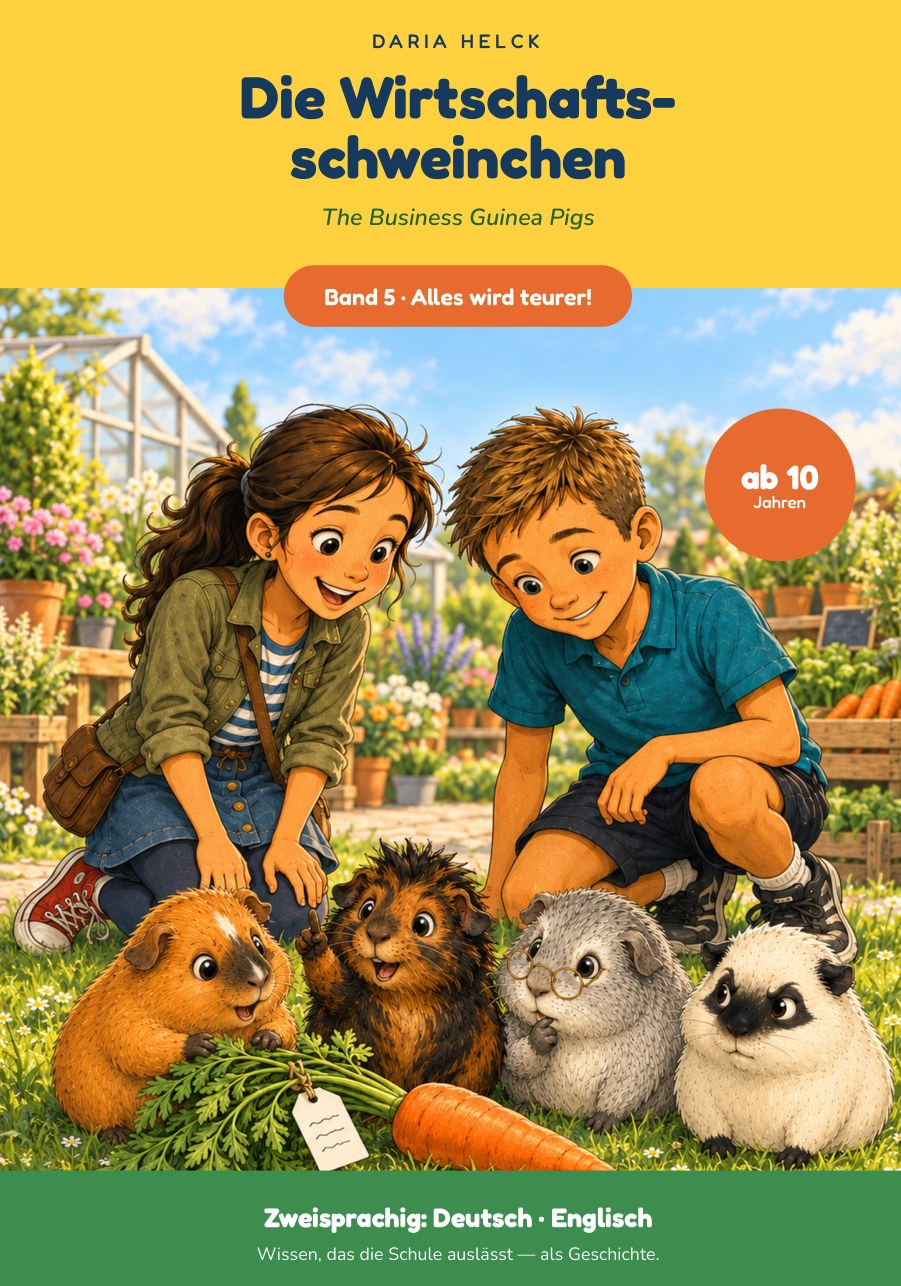
Volume 5 · Everything Costs More!
About the series: all volumes and characters All the characters in the series