Home › The Business Guinea Pigs › Volume 1
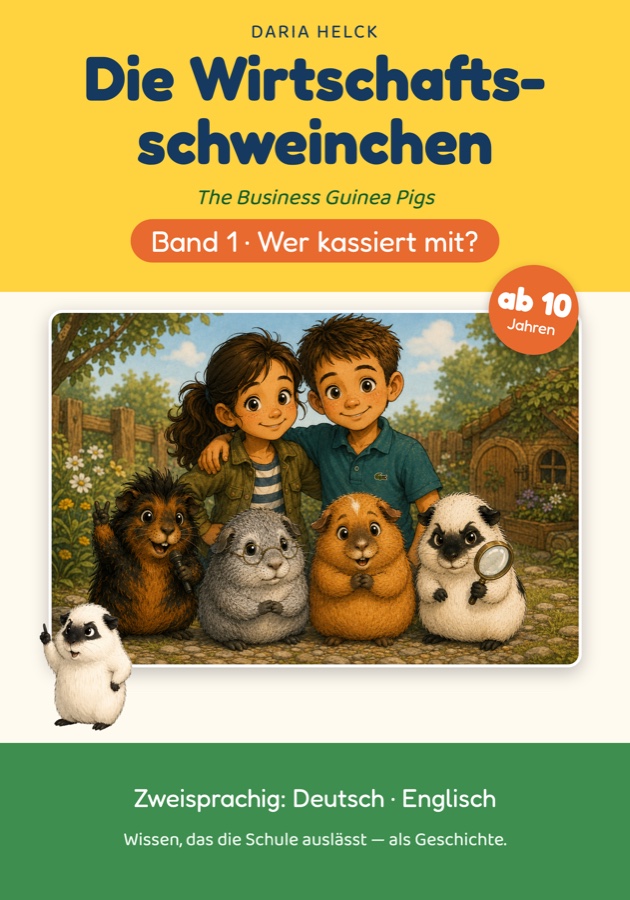
Volume 1 · ages 10+
Topic: taxes
The Business Guinea Pigs – Volume 1: Wer kassiert mit? (Who takes a cut?)
Taxes explained simply for kids: a story from a lemonade stand.
A hot Saturday, lots of lemons and an idea: Daria and Christian open a lemonade stand. By the end of the day they have made €11.70 in profit. Then their neighbor Mr. Berger stops with his newspaper and asks whether they are being good and paying their taxes.
Neither of them knows what taxes are. Luckily, four guinea pigs live in the backyard, and they know more about money than plenty of grown-ups.
- By Daria Helck, published by FLITCH UG
- For kids ages 10+, roughly grades 5 to 7
- Bilingual: every paragraph in German, with the English right below it
- 38 pages, illustrated in full color throughout
- Available as a paperback and as a Kindle eBook
What Volume 1 is about
Daria has the ideas, Christian does the math. Before the first cup is filled, he already knows what the stand costs: one euro for sugar, eighty cents for cups, and the lemons are free. Daria saves on the cups and puts her effort into a big sign instead, because everyone sees that. It works. Twenty-seven glasses later, the cash box is full.
Then Mr. Berger comes along, and with him the question that gives the book its title: Who is actually taking a cut here? Rocky turns it into a big show, Mojito reads the fine print, Mr. Grey brings in the ancient Romans. And Toffy asks the question that has everyone thinking by the end: Is that actually fair?
Taxes explained simply: what Volume 1 teaches
The book answers these questions. Here is a short summary, with the examples from the story.
What is the difference between revenue, costs and profit?
Christian explains it at the stand: revenue is all the money that comes in. Costs are all the money that goes out, for example for sugar and cups. Profit is what is left over, so revenue minus costs. At the lemonade stand that means: 27 glasses at 50 cents each make €13.50 in revenue. Minus €1.80 in costs, that leaves €11.70 in profit.
What is a loss?
When more money goes out than comes in. In the book, Christian says it in four words: More out than in. That’s why, before they start, he works out the minimum number of glasses they have to sell for the stand to be worth it at all.
What is worth spending money on?
Daria has a clear rule for this: blowing money is dumb, but putting money in the right place is smart. You have to spend money to make money. She saves on the cups, because they end up in the trash anyway. She puts her effort into the sign, because everyone sees it and it brings customers to the stand.
What are taxes? Explained for kids
Mojito explains it like this: when you earn money in Germany, you give part of it to the government. That part is called tax. His picture for it is a shared food bowl. Every morning everyone puts something in, as much as they can. And then everyone gets to eat from it, even those who had nothing today or are sick. Taxes are the shared food bowl of an entire country.
Why do we pay taxes, and what are they used for?
Mr. Grey sums it up: a single family can’t build a road, a hospital or a fire department. If everyone chips in, it works. The road in front of the house, the school, the traffic light on the corner and the fire department are paid for with taxes. His line on this: A community needs contributions.
Who collects the taxes?
The tax office. Christian wants to know who actually makes sure that everyone really puts something in the bowl. Mojito’s answer: there is a separate government office for that, the tax office. And it always reads the fine print.
How long have taxes existed?
The ancient Romans were already collecting taxes more than two thousand years ago. They used them, for example, to build roads across Europe on which traders could travel safely. When Daria asks whether it has been annoying people for that long, Mr. Grey answers: It has been holding people together for that long.
Does everyone pay the same amount of tax?
No. That’s exactly what Toffy wants to know, and Mr. Grey explains: in Germany, the more you earn, the more you pay. This is called a progressive tax rate, rising step by step like on a scale. Politicians still argue today about whether that is fair. Mojito’s take: Fairness questions rarely have just one answer.
Do kids have to pay taxes on a lemonade stand?
Not on the €11.70 from the stand. In Germany, you only pay income tax once you earn more in a year than a certain limit, the basic allowance. No tax office is going to come knocking over that, says Rocky. Mojito adds one more thing: When you have a real company one day, the tax will come. And then it’s good if you already know how it works.
The explanations in the book and on this page are simplified for kids.
The most important lines from the book
In the book, every paragraph is in German, with the English right below it. Same here.
„Man muss Geld ausgeben, um Geld zu machen. Das ist der ganze Trick.“
“You have to spend money to make money. That’s the whole trick.”
„Und Gewinn: das, was übrig bleibt. Einnahmen minus Kosten.“
“And profit: what’s left over. Revenue minus costs.”
„Und denkt dran — irgendwer kassiert immer mit.“
“And remember — somebody always takes a cut.”
„Das sind Steuern. Die gemeinsame Futterschüssel von einem ganzen Land.“
“Those are taxes. The shared food bowl of an entire country.”
„Eine Gemeinschaft braucht Beiträge. Wer dazugehört und etwas hat, gibt etwas zurück.“
“A community needs contributions. Those who belong and have something give something back.”
„Das ist das Verrückte an fairen Fragen — sie haben selten nur eine Antwort.“
“That’s the tricky thing about fairness questions — they rarely have just one answer.”
Words from the book: German and English
At the back of the book is the Business Guinea Pigs’ dictionary. Here is a selection:
Einnahmen · revenue
All the money that comes in.
Kosten · costs
All the money that goes out.
Gewinn · profit
Revenue minus costs. What’s left over.
Verlust · loss
When more goes out than comes in.
Steuer · tax
Part of the money you earn goes to the government, for schools, roads and hospitals.
Finanzamt · tax office
The government office that collects taxes.
Progressiver Steuersatz · progressive tax
The more you earn, the more you pay.
Grundfreibetrag · basic allowance
Up to a certain amount per year, you pay no income tax at all.
Vertrag · contract
A firm agreement that everyone has to keep. That’s what Volume 2 is about.

A word from Daria
Dear parents, much of what really matters in life I only learned as an adult — with a lot of time and, to be honest, a lot of money. How money works. Why taxes exist. How to start bravely, fail wisely and know your own worth. We often learn the most important things far too late, usually the hard way.
Kids grasp these things early and effortlessly — if you explain them at eye level, with humor and without wagging a finger.
That’s exactly what the Business Guinea Pigs are for: four clever guinea pigs who explain, and two kids who live through it. A story to laugh about — and, along the way, the knowledge that school leaves out. Bilingual, because knowledge might as well be useful twice over.
Daria Helck in the afterword of Volume 1
Join in and keep talking
At the back of the book there’s a profile page just for your child. Your child fills in a business idea of their own and writes down what they would do with the profit. And they get to draw their own Business Guinea Pig. If your child likes, they can then work the idea through the way Christian does: What does it cost, what comes in, what’s left over?
Questions to keep the conversation going
- What would you spend money on at your stand, and what wouldn’t you?
- What on your street is paid for with taxes?
- Do you think it’s fair that someone who earns more pays more taxes? Why?
- What would you do with €11.70 in profit?
What’s inside the book
- 10 chapters, one continuous story
- Every paragraph in German, with the English right below it
- The Business Guinea Pigs’ dictionary with 13 terms in German and English
- Profiles of all six characters
- A profile page of your own to fill in, with a business idea and space to draw
- A word to parents
- 38 pages, illustrated in full color throughout
The other volumes
Each volume explains a different big topic and can be read on its own.
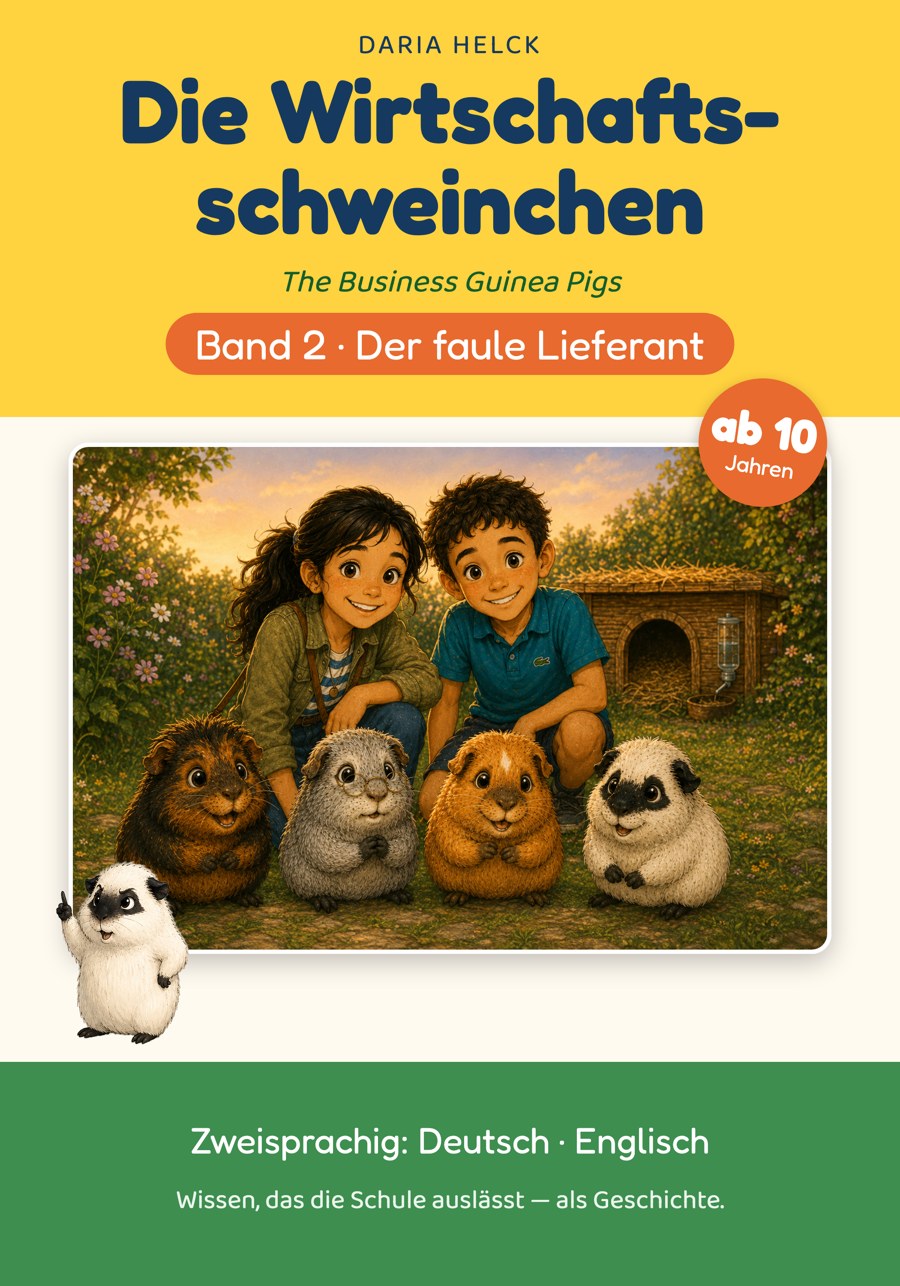
Volume 2 · The Lazy Supplier
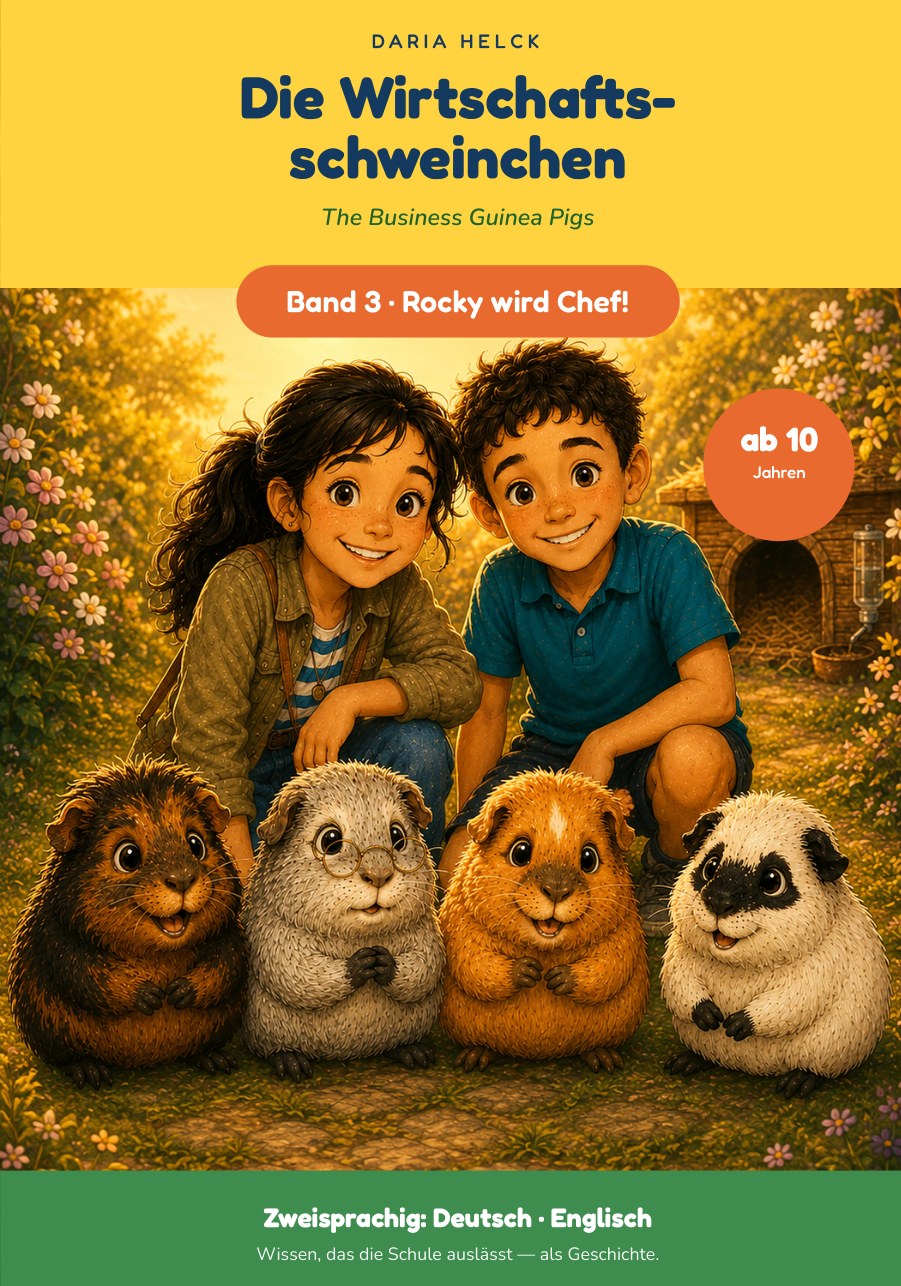
Volume 3 · Rocky Becomes the Boss!
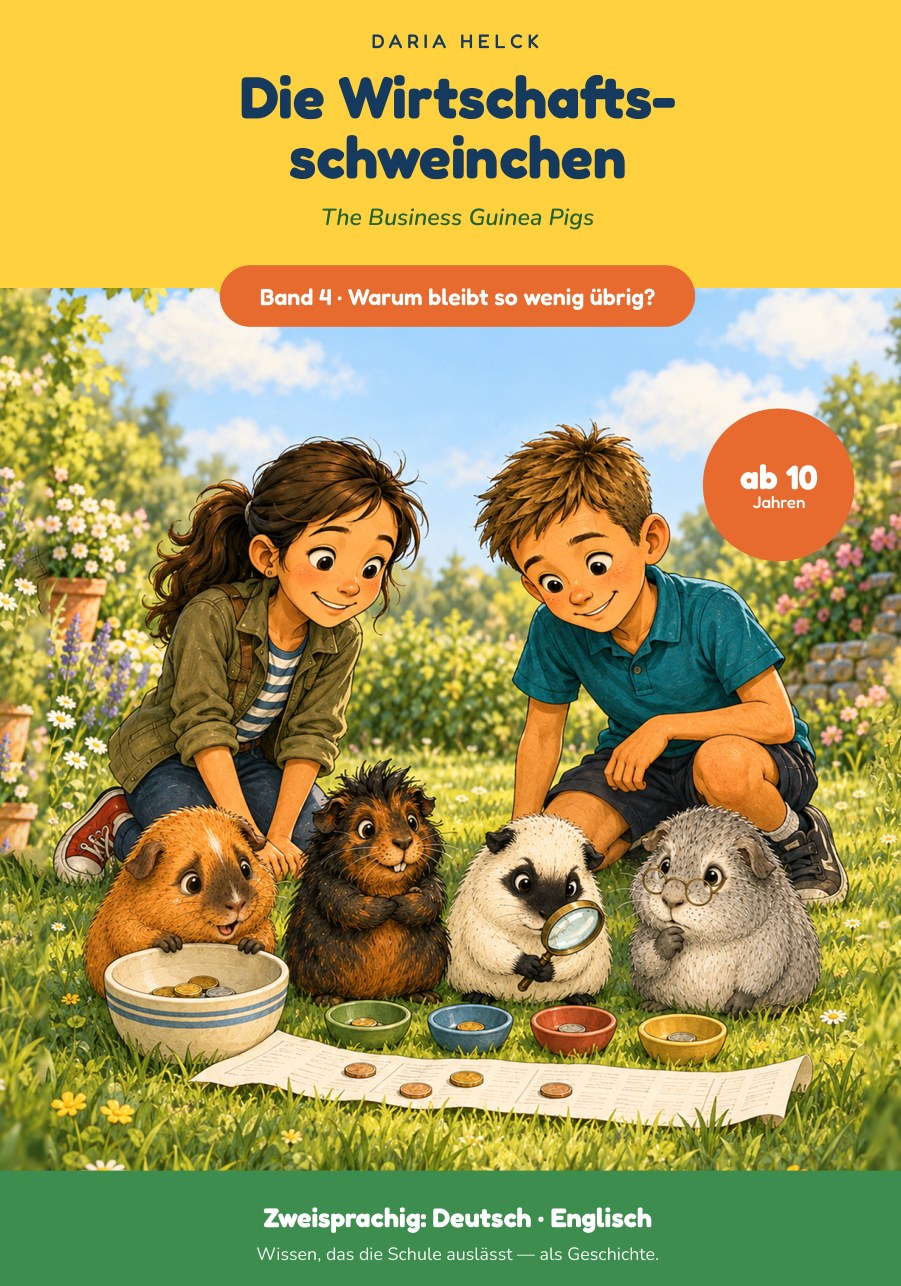
Volume 4 · Why Is So Little Left?
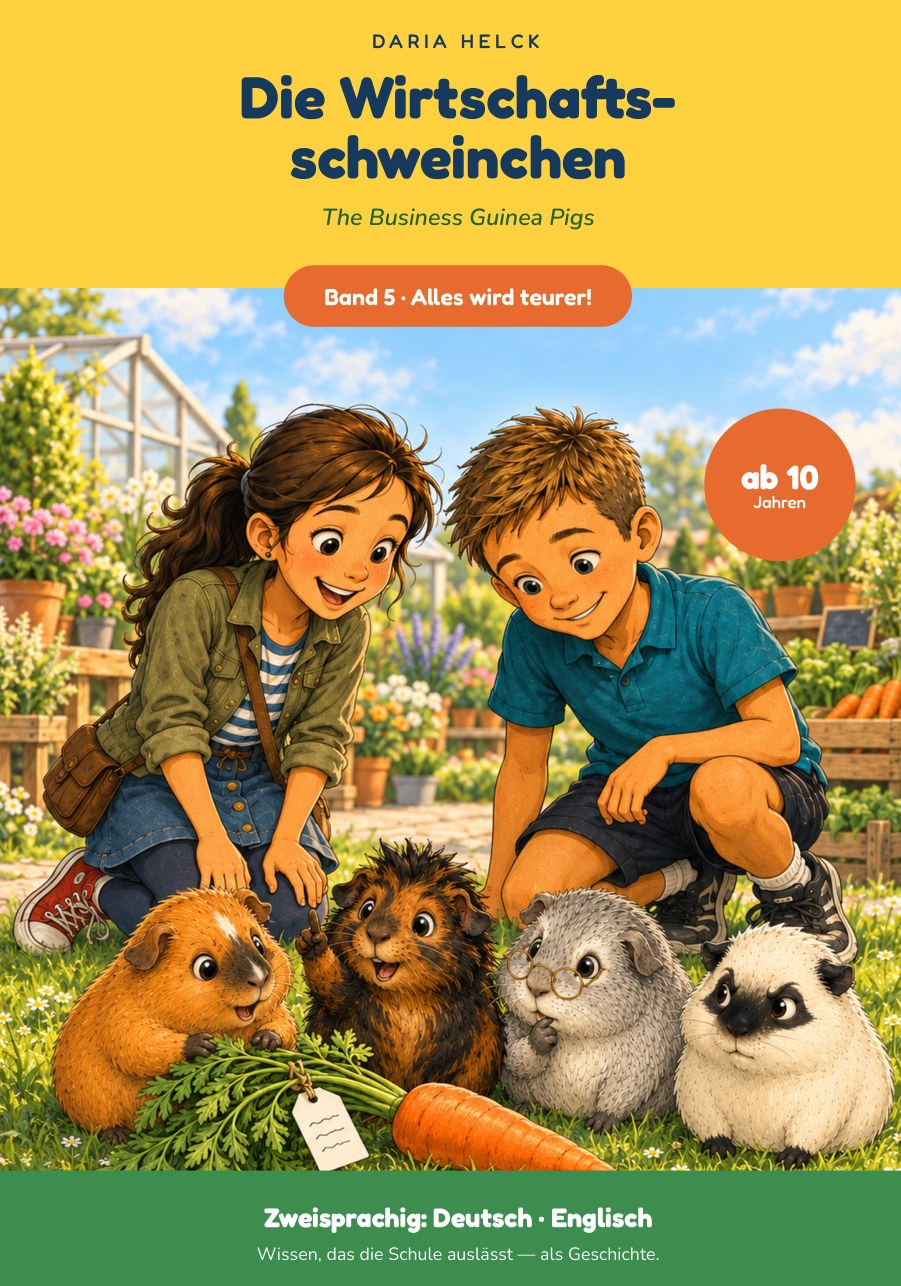
Volume 5 · Everything Costs More!
About the series: all volumes and characters All the characters in the series